I found this link on a forum that I frequent. It's definitely an interesting article.
I'd be willing to say that a lot of people are afraid to let go of their previous memories and fantasies that they experienced when playing those games (just like their childhood). They're "comfortable" accepting those past realities that they never stopped to question as they grew older - and a slightly grander, "more epic", version of something which really hasn't grown on the inside is just the panacea to stop their new reality from creeping up to the surface. It's like the counter to that feeling you get when trying to force-ably relive an old memory, and it just doesn't feel quite the same as it did then when it was full of wonder and awe - so you add a coat of gloss on top and say "see, it's just as good and the formula hasn't changed (or forced me to change)".
The forum post is here.
I said the exact same thing there - but it was an interesting topic and it ties in with a lot of points that I feel strongly about (some relating to the direction that games are taking as a medium, and others relating more to people... people I know, and people in society in general).
EDIT: I think that I should add that this provided an interesting moment of reflection for myself. It's easy to fall into the trap of dreaming about and trying to recreate positive moments from that past - particularly when you don't want to face a particular challenge or hardship in the present. I don't think that thinking about the past is bad - as a matter of fact, it can help to ground us and remind us of who we are - but it is the context that matters more than the experience itself. As said above, those memories that stick with us were often full of wonder, awe; and also, we were often pushing new boundaries. I think that is one of the most important things to remember - at it is what is missed when we try to recreate a perfect image of the past. Recreating a memory in the present puts it out of context because often what really mattered was the fact that we were growing and pushing the boundaries that we were familiar with - be it with a narrative theme, an accomplishment, an experience with another person or persons, or whatever else left a lasting impression.
Friday, May 14, 2010

BasicEffect in XNA
All right, so as I'll probably elaborate at some point in the future I've been working on learning programming for just over a year now and have been working on a game project in C# using Microsoft's XNA framework. Well, to be more exact I've been learning how to use it which has been going on since about January.
I'll talk more about the project in another post, but I just finished spending several hours (and several more flipping to other things since I couldn't figure out was wrong and figured I needed to step back for a bit) trying to draw a simple little triangle to the screen. More specifically, I'm working with primitives in a 3D environment and was trying to get a simple triangle with colored vertices.
It's simple enough to draw basic sprites, or even 3D models to the screen (though the models require matrix transformations, but even if you haven't done linear algebra or worked with matrices they're not that hard to implement if you follow a straight forward tutorial and try to grasp the concept). Primitives shouldn't be that much harder, even with having to work with implementing shader effects (in XNA you can use their BasicEffect class which isn't too complex if you don't want it to be), but it still proved to be frustrating - though this was more due to (my) human error than anything about the task itself.
I've been using this site, and I highly recommend his tutorials for anyone interested in working with XNA. He doesn't really get into object-oriented approaches, which start to get important when you're working on a full game and your code gets long and complex, but if you're jumping into XNA you should have a decent understanding of C# already. Anyway, I implemented his code pretty much exactly as he shows it - the difference being that I created my own primitives class since I'm going to be working with primitives in my project.

I combed through the code and didn't see anything, so then tried copying his implementation into a new project (he provides the source code) and it worked fine. From there, I cross-referenced everything that was going on to compare it to my code, tried putting parts of my code into the main class to test it, etc; but nothing worked. I just got a screen with the default blue background. Turns out it was something simple.

I'll talk more about the project in another post, but I just finished spending several hours (and several more flipping to other things since I couldn't figure out was wrong and figured I needed to step back for a bit) trying to draw a simple little triangle to the screen. More specifically, I'm working with primitives in a 3D environment and was trying to get a simple triangle with colored vertices.
It's simple enough to draw basic sprites, or even 3D models to the screen (though the models require matrix transformations, but even if you haven't done linear algebra or worked with matrices they're not that hard to implement if you follow a straight forward tutorial and try to grasp the concept). Primitives shouldn't be that much harder, even with having to work with implementing shader effects (in XNA you can use their BasicEffect class which isn't too complex if you don't want it to be), but it still proved to be frustrating - though this was more due to (my) human error than anything about the task itself.
I've been using this site, and I highly recommend his tutorials for anyone interested in working with XNA. He doesn't really get into object-oriented approaches, which start to get important when you're working on a full game and your code gets long and complex, but if you're jumping into XNA you should have a decent understanding of C# already. Anyway, I implemented his code pretty much exactly as he shows it - the difference being that I created my own primitives class since I'm going to be working with primitives in my project.

I combed through the code and didn't see anything, so then tried copying his implementation into a new project (he provides the source code) and it worked fine. From there, I cross-referenced everything that was going on to compare it to my code, tried putting parts of my code into the main class to test it, etc; but nothing worked. I just got a screen with the default blue background. Turns out it was something simple.
vertices = new VertexPositionColor[3];I created and recreated the same vertice three times instead of creating 3 different vertices. Just goes to show how debugging can be (and from what I've experienced, usually is) the most frustrating part of the process. Of course, it felt great to figure out what the problem was (and I suppose that I gained a much more thorough understanding of the GraphicsDevice and SimpleEffect classes since I was getting pretty certain that the problem lied with one of those two).
vertices[0] = new VertexPositionColor(new Vector3(0, 1, 0), Color.Red);
vertices[0] = new VertexPositionColor(new Vector3(0.5f, 0, 0), Color.Green);
vertices[0] = new VertexPositionColor(new Vector3(-0.5f, 0, 0), Color.Blue);

Tuesday, May 11, 2010
Hello, first active topic on my mind "Oil vs Gold Prices and Monetary Inflation"
To start, I'd like to say that I'm going to post about anything and everything that I find interesting, important, and worth a spot on this page. I often find myself spending hours researching particular topics until the wee hours of the night, and I thought that I may as well come up with something to show for it (and possibly even provide a source of interest for others).
What I want to talk about today stemmed from a youtube video, linked just below, about peak oil. Actually, the guy (Loren) has many other great videos as well - I'd encourage you to check them out:
I don't necessarily agree with a lack of focus on global warming (although to be honest, I'm more concerned about how much carbon dioxide we're pumping into the atmosphere for a multitude of reasons, whether global warming is a major byproduct of CO2 production or not). I think that he does present a great job of pointing out the limitations of the media's coverage regarding these topics. They hyper-focus on things like carbon trading while neglecting several other major (and likely more important and changeable) issues.
Anyway, I got reading the comments below the video and there was a guy saying that the only reason that the price of oil would go up is because of monetary inflation, and it can be shown by oil's near constant correlation with the price of gold. In the mindset of thinking about peak oil, I was skeptical about his claim. I thought to myself, "what about the Gulf Oil Crisis" or the undeniable fact that we do indeed have limited reserves of oil on this planet" - particularly in easy and cheap to extract forms. Bitumen and shale oil for example are quite expensive and take tens or hundreds of billions of dollars in investment to get operational on a large scale - and even then it takes awhile to ramp up the capacity.
Turns out, whether you agree or not that gold is an accurate reflection of true value that the correlation is pretty much exactly as he said. Even during the Gulf Oil Crisis, the price of oil rose in tandem with gold and the ratio between the two did not change substantially. This fits with the fact that there was massive inflation during the 70s and a big increase increase in the money supply (78% if I remember correctly - which means that by the end of the 70s there were 0.78 cents created for every dollar that people had, increasing the price of goods and decreasing the value of their savings). This made me wonder what the current trend is.
I decided to do some research. As said in that video (and verified by myself - though I'd definitely encourage you to check for yourself), the amount of oil put on world markets actually peaked back in 2005 while natural gas increased slightly to give an ever so slight increase in net energy production. Hey, oil prices were getting pretty high too prior to the recession, the fall in the price of oil, and the US government printing money like it's toilet paper (which preceded and happened as the price of oil rose again and the value of the dollar fell). With the economy being hot prior to the recession and the production of oil capped, I thought to myself that for sure oil prices would be high compared to gold. Turns out that any differences were pretty minimal and the ratio between the price of gold and oil were not far off each other:
Gold-Oil ratio 2000-09
So, what's the relationship? Many people feel that gold reflects true value as a currency with little change in supply, though in enough abundance that it's not impossible to obtain. It was formerly used as a backing for currency under the gold standard. As a matter of fact, the massive inflation in the 70s occurred around the time that US currency went from the gold standard to fiat - or in other words from an asset based currency to one based upon trust in the economy, the government, and its own intrinsic worth as a means of trading value - but that's another topic. Oil, funny enough, tends to go up in price when large amounts of money are printed and the value of the US dollar goes down. Gold does the same thing (and follows oil almost exactly). Whether this is because gold is used as a hedge against a falling dollar, or gold reflects true value, both it and oil pretty much go hand in hand in terms of price. Here's another graph showing world oil production from 1965 to 2003 (notice the little blip in the 70s - that's the typical explanation for more than doubling oil prices):
Global oil production 1965 to 2003
Going back to peak oil, I still don't believe that it's a non-issue. From the gold-oil relationship you could infer that oil has only risen in price due to inflation in the monetary supply and there have been no major increases in actual oil prices for the past half-century (this is using gold as a measure of value, since even with adjusted inflation the price was higher in the 70s and is higher now than at other times). One could say that, "well, peak oil is a myth and the price will only go higher because of inflation - there's nothing to be concerned about except the monetary supply". I have to disagree though.
Even given the previous argument concerning gold and oil, that doesn't change the inevitable decline of worldwide oil production. I do not know the precise estimates for untapped reservoir potential, but concerning oil that we can get at readily with minimal refinement it's not very high (light sweet crude). Even including heavy oil sources like the Venezuelan heavy oil reserves and Alberta tar sands (I live here currently, and politically it's a no-no to say "tar" instead of "oil", despite that being more akin to what it is) our long term production capacity just isn't there, and the processing methods are incredibly energy intensive. It's true that there are many countries and groups that don't share exact oil reserves for security/national reasons, but even still the continued growth of oil production to meet growing energy needs just doesn't look viable given the increasingly short supply of oil that we have easy access to.
Of course, maybe the world's energy concerns will be mitigated by innovative new tech like this:
Intellectual Ventures TerraPower
That will have to be the topic of a future post however.
What I want to talk about today stemmed from a youtube video, linked just below, about peak oil. Actually, the guy (Loren) has many other great videos as well - I'd encourage you to check them out:
I don't necessarily agree with a lack of focus on global warming (although to be honest, I'm more concerned about how much carbon dioxide we're pumping into the atmosphere for a multitude of reasons, whether global warming is a major byproduct of CO2 production or not). I think that he does present a great job of pointing out the limitations of the media's coverage regarding these topics. They hyper-focus on things like carbon trading while neglecting several other major (and likely more important and changeable) issues.
Anyway, I got reading the comments below the video and there was a guy saying that the only reason that the price of oil would go up is because of monetary inflation, and it can be shown by oil's near constant correlation with the price of gold. In the mindset of thinking about peak oil, I was skeptical about his claim. I thought to myself, "what about the Gulf Oil Crisis" or the undeniable fact that we do indeed have limited reserves of oil on this planet" - particularly in easy and cheap to extract forms. Bitumen and shale oil for example are quite expensive and take tens or hundreds of billions of dollars in investment to get operational on a large scale - and even then it takes awhile to ramp up the capacity.
Turns out, whether you agree or not that gold is an accurate reflection of true value that the correlation is pretty much exactly as he said. Even during the Gulf Oil Crisis, the price of oil rose in tandem with gold and the ratio between the two did not change substantially. This fits with the fact that there was massive inflation during the 70s and a big increase increase in the money supply (78% if I remember correctly - which means that by the end of the 70s there were 0.78 cents created for every dollar that people had, increasing the price of goods and decreasing the value of their savings). This made me wonder what the current trend is.
I decided to do some research. As said in that video (and verified by myself - though I'd definitely encourage you to check for yourself), the amount of oil put on world markets actually peaked back in 2005 while natural gas increased slightly to give an ever so slight increase in net energy production. Hey, oil prices were getting pretty high too prior to the recession, the fall in the price of oil, and the US government printing money like it's toilet paper (which preceded and happened as the price of oil rose again and the value of the dollar fell). With the economy being hot prior to the recession and the production of oil capped, I thought to myself that for sure oil prices would be high compared to gold. Turns out that any differences were pretty minimal and the ratio between the price of gold and oil were not far off each other:
Gold-Oil ratio 2000-09
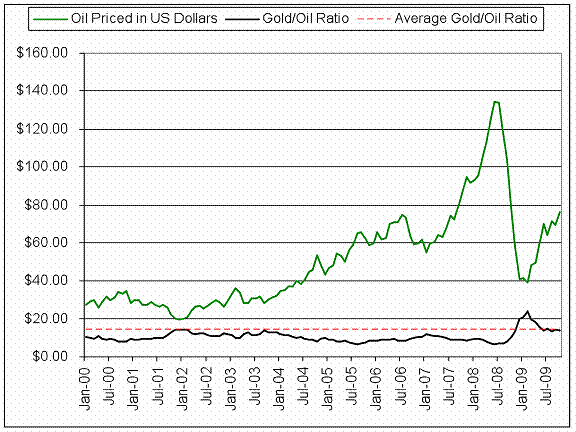
So, what's the relationship? Many people feel that gold reflects true value as a currency with little change in supply, though in enough abundance that it's not impossible to obtain. It was formerly used as a backing for currency under the gold standard. As a matter of fact, the massive inflation in the 70s occurred around the time that US currency went from the gold standard to fiat - or in other words from an asset based currency to one based upon trust in the economy, the government, and its own intrinsic worth as a means of trading value - but that's another topic. Oil, funny enough, tends to go up in price when large amounts of money are printed and the value of the US dollar goes down. Gold does the same thing (and follows oil almost exactly). Whether this is because gold is used as a hedge against a falling dollar, or gold reflects true value, both it and oil pretty much go hand in hand in terms of price. Here's another graph showing world oil production from 1965 to 2003 (notice the little blip in the 70s - that's the typical explanation for more than doubling oil prices):
Global oil production 1965 to 2003
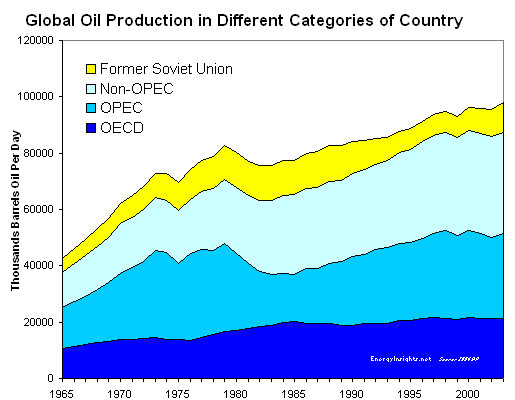
Going back to peak oil, I still don't believe that it's a non-issue. From the gold-oil relationship you could infer that oil has only risen in price due to inflation in the monetary supply and there have been no major increases in actual oil prices for the past half-century (this is using gold as a measure of value, since even with adjusted inflation the price was higher in the 70s and is higher now than at other times). One could say that, "well, peak oil is a myth and the price will only go higher because of inflation - there's nothing to be concerned about except the monetary supply". I have to disagree though.
Even given the previous argument concerning gold and oil, that doesn't change the inevitable decline of worldwide oil production. I do not know the precise estimates for untapped reservoir potential, but concerning oil that we can get at readily with minimal refinement it's not very high (light sweet crude). Even including heavy oil sources like the Venezuelan heavy oil reserves and Alberta tar sands (I live here currently, and politically it's a no-no to say "tar" instead of "oil", despite that being more akin to what it is) our long term production capacity just isn't there, and the processing methods are incredibly energy intensive. It's true that there are many countries and groups that don't share exact oil reserves for security/national reasons, but even still the continued growth of oil production to meet growing energy needs just doesn't look viable given the increasingly short supply of oil that we have easy access to.
Of course, maybe the world's energy concerns will be mitigated by innovative new tech like this:
Intellectual Ventures TerraPower
That will have to be the topic of a future post however.
Subscribe to:
Posts (Atom)